The broad field of mathematical billiard problems studies billiard-like behavior in a confined shape. The first question of this type belonged to Giovanni Fagnano: Which triangles, inscribed within an acute triangle, will have the smallest perimeter? My research deals with different content than Fagnano, but retains a similar form.
I will be investigating the behavior of masspoints on polygon-shaped billiard tables in an idealized environment:
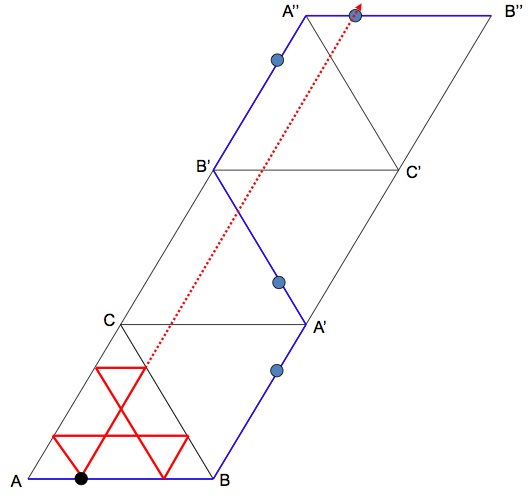
In 2008, Dr. Andrew Baxter, my research mentor this summer, published a paper in which he counted and classified the periodic orbits in an equilateral triangle. One special property of the equilateral triangle is its ability to tessellate the plane through edge reflections alone, i.e. with equilateral triangular tiles, one can completely tile a two-dimensional surface (with no holes). Looking at the grid formed by triangular tessellations, Dr. Baxter was able to create a coordinate system of unit rhombuses (made by two unit triangles) to study classes of periodic orbits. The coordinate system is useful because it allows one to study a periodic orbit, not as a complex, piecewise function within the confines of a single triangle, but rather as an unfolding , a straight line through a plane tiled with equilateral triangles. This technique permits the study of a single line passing through a series of reflected triangles. Each unfolding of an orbit can be labelled like a vector, based on its ending point (the initial position is (0,0)), with an (x,y) coordinate, determined by the coordinate system in which the shape fits best (square coordinates, rectangular coordinates, rhombic coordinates, etc.).There are only seven shapes that are able to edge-tessellate the plane in this unique way. This summer, I will study the six other polygons, attempting to perform an analogous task: Count and classify the periodic orbits of all seven shapes, comparing the commonalities and fundamentals of orbits between different shapes.