Formalising Graph Theory in
Jakub Štepo
DIMACS REU 2026

Collaborators
I am an undergaduate student at Charles University in Prague.
I will be working under the guidance of Atefeh Mohajeri, a research scientist at

Other people joining us on our experience with Lean:
-
Shiyu Wang, a student at Columbia University and intern at Bell Labs
-
professor Bjørn Kjos-Hanssen of the University of Hawaii at Manoa
Acknowledgements
This work will be conducted at the Center for Discrete Mathematics and Theoretical Computer Science of Rutgers University.
Furthermore, the following entities provide financial support:


Made using VersoSlides
Copyright (c) 2026 Lean FRO LLC. All rights reserved.
Released under Apache 2.0 license.
Author: David Thrane Christiansen
Modified from the official Demo.
History
The way we view mathematics has developed.
-
The notion of a proof: Thales, cca 600 BC
-
The ε-δ definition of a limit as a rigorous way of doing analysis: Bolzano, 1821
-
ZFC as a solid foundation: 1922
But is it enough?
We don't prove everything formally in practice!
Formal mathematics
Lean is a functional programming language which allows for formal proof verification. (de Moura, 2013)
-
Natural next step in the evolution of mathematics
-
Absolute guarantee of correctness
-
Open-source, collaborative effort
-
Lean's math library, mathlib, currently contains over 130000 definitions and 270000 theorems/lemmas
Let's take a closer look!
How it works
-
Dependent type theory (in contrast to set theory)
-
Logical strength: ZFC + finitely many inaccessibles
-
Lean checks that a term has the correct type
-
Curry-Howard correspondence: The terms of propostitions (as types) are simply proofs
def f (k : ℤ) : ℕ × ℕ → ℤ :=
  fun (m, n) ↦ k * (m - n)

theorem impl_trans (P Q R : Prop) : (P → Q) → (Q → R) → (P → R) :=
  fun hpq hqr ↦ hqr ∘ hpq
How it looks
-
Tactic mode: The proof is written quite naturally
-
Powerful automation implemented
-
Extensibility: One may write their own tactics
-
Proof assistant: interactive environment
example : ¬ ∃ n : Nat, n ^ 2 = 3 := by
intro h
obtain ⟨n, hn⟩ := h
match n with
| 0 => contradiction
| 1 => contradiction
| k + 2 =>
have : 3 ≥ 4 := by
calc
3 = (k + 2)^2 := hn.symm
_ ≥ 2 ^ 2 := by lia
contradiction
More on Lean
-
Also verifies computer programs → use in cybersecurity
-
Useful for checking the soundness of AI output
-
AI agents might be useful for translating papers into Lean code
-
One can write websites, textbooks, slides etc. with interactive code in Lean
The state of the art
Most topics of undergraduate mathematics are already covered really well.
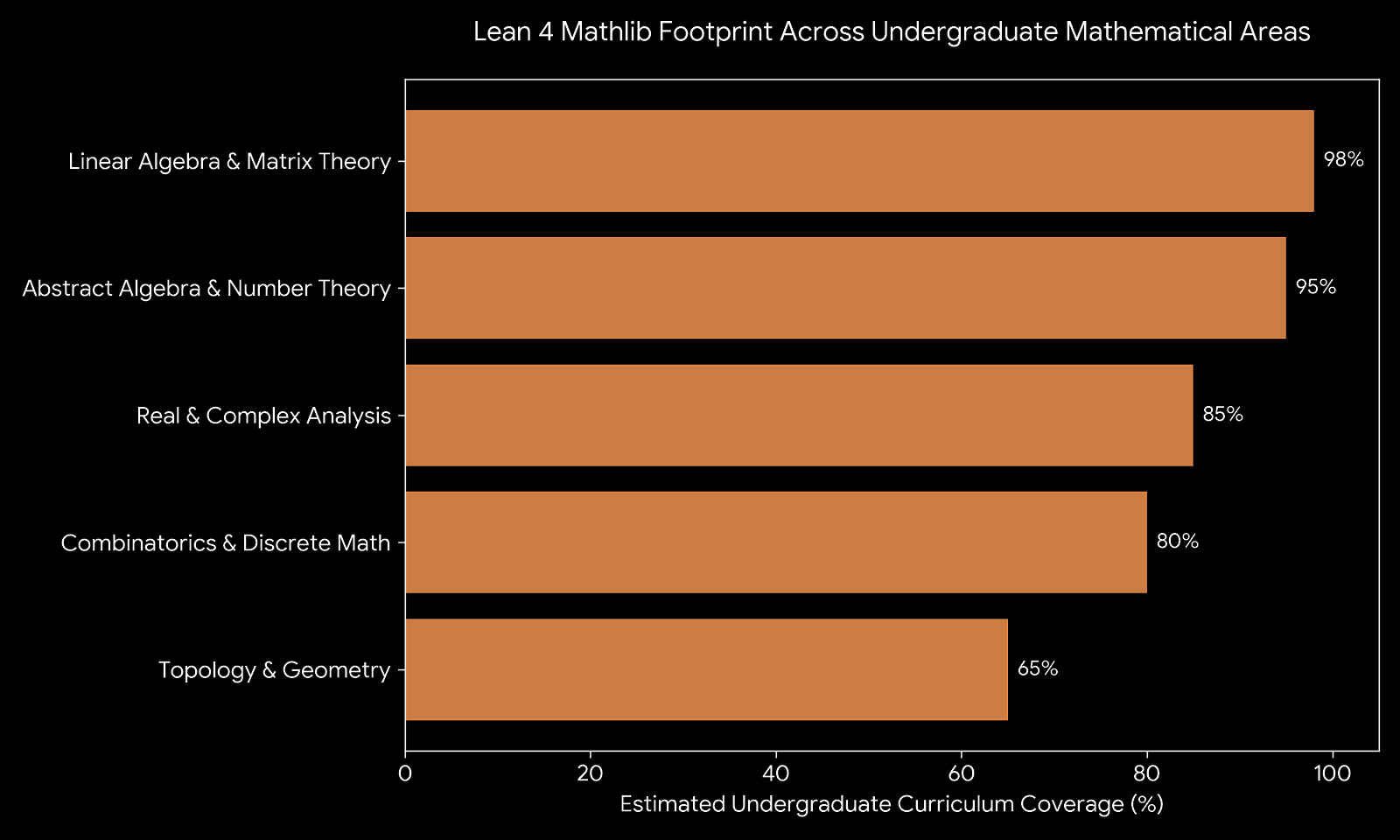
Image by Gemini
What I will be doing
Graph theory appears relatively underdeveloped, even some basic results are missing
-
First, survey what areas already are formalised and how
-
Then attempt to formalise a topic not yet in Mathlib and see what challenges it brings
-
What makes some things difficult and which new approaches are necessary?
Thank you for your attention!