
Recall that an algebra is merely a vector space, A, equipped with a bilinear map which prescribes the multiplication of vectors. The Cayley-Dickson Process affords a means of building a larger algebra, B, which contains A as a subalgebra. In particular, we shall use it to construct the Octonions from the Real numbers.
Suppose A is an algebra over a field, K. Suppose, further, there exists a map from A onto itself. This map, which we shall henceforth call conjugation, is denoted with an overscore and subject to the following relations:
We begin constructing B by first considering all ordered pairs with entries valued in A. Vector space operations are readily defined on B, thereby making it into a vector space in its own right:
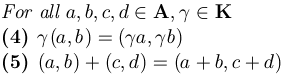
As a vector space, B has twice the dimension of A; it is for this reason that construction acquires the affectionate title of "Cayley-Dickson Doubling." (In the infinite dimensional case, dimension is defined in terms of infinite cardinals; and thus, the notion of "double" becomes somewhat less tangible. Still, if the sets U and V are bases for A and B respectively, then V can quite easily be put into bijection with {0,1} × U. We, however, shall be restricting our consideration to finite dimensional vector spaces, thus rendering any such transfinite tomfoolery moot.)
We must now equip B with suitable analogues of multiplication and conjugation. We multiply vectors in B (i.e. ordered pairs of elements in A) by the following rule:

The incredulous reader may wish to verify that (6) does, indeed, define a bilinear map from B×B into B. If A is unital with multiplicative identity, 1, then (1,0) is visibly the corresponding unit element for B. By considering all pairs whose latter coordinate is 0, we obtain a very intuitive embedding of A into the "double algebra" of B
In B, we use a superscript asterisks (*) to denote conjugation so that we may distinguish it from that which has already been defined for A:

Verifying that our definition in (7) is an involutive antiautomorphism (i.e. satisfies conditions (1)-(3)) is left as a straightforward exercise to the reader.
Admittedly, there doesn't appear to be much motivation lying behind the Cayley-Dickson formulas; that these nebulous incantations do indeed define the desired double-algebra, B, seems somewhat of a miracle. It so happens that there does exist an injective algebra homomorphism which elucidates the multiplication quite nicely.

The catch, however, is that we must adopt a new rule for matrix multiplication:

Those familiar with Lie Algebras are no-doubt well-acquainted with the bilinear commutator, [·,·], given by [x,y] = xy - yx. In particular, the commutator is zero when its arguments commute; so when A is commutative, (9) reduces to familiar matrix multiplication, and B will consequently be associative.