William Feldmann 2011
REU Project
Email: willvf@eden.rutgers.edu Skype name:
willvf333
I am working with Dr. Roderich Tumulka on the feasibility of GRW theory. GRW is an alternative to quantum mechanics that says wavefunctions collapse spontaneously instead of when measurements are taken (as in quantum mechanics).
In GRW theory, wavefunctions (of a single particle) collapse stochastically with a specified rate (λ). The value of λ is not set by the theory, it is an adjustable parameter. λ can be a constant, or it can be related to the mass or energy of the particle.
The nature of collapse is governed by another parameter (σ) that is associated with a Gaussian collapse function.

xn, yn, and zn are the coordinates of the nth particle, one whose wavefunction collapsed. xc, yc, and zc are the coordinates of the center of collapse, which is random and has the following probability density:

Ψ is the wavefunction of the whole system at the time collapse occurs.
The effect of collapse is:

Where Ψ’ is the new, collapsed wavefunction. After collapse, Ψ’ will mature according to the Schrodinger equation.
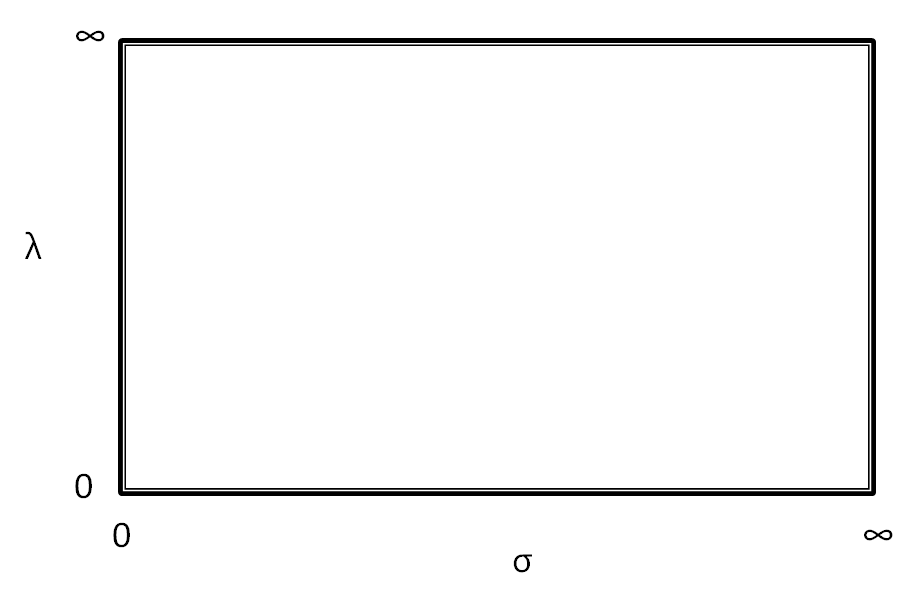
The values of σ and λ can potentially range from 0 to infinity which is shown in the figure below. My job is to decide what regions of the graph correspond to values of the parameters that don’t fit with observations.
Week 1
I have investigated the effect of wavefunction
collapse on one dimensional Gaussian wavefunctions of one free particle. It
turns out that every collapse, regardless of where it occurs, adds  energy to the
particle if the Gaussian has no imaginary component.
energy to the
particle if the Gaussian has no imaginary component.
For a complex Gaussian, collapse can increase or decrease
the energy of the particle. The algorithm I developed allows for measuring the
change in energy of the system over an adjustable range of collapse points.
Weeks 2-3
I
have also looked into the change in energy for hydrogen ground state
wavefunction collapses. Assuming  ,
which is the expected
value (p.11), the average change in energy per collapse is
,
which is the expected
value (p.11), the average change in energy per collapse is  or
or  .
.
This is similar to the value of  that comes from Bassi’s free
particle energy change formula (p.53).
that comes from Bassi’s free
particle energy change formula (p.53).
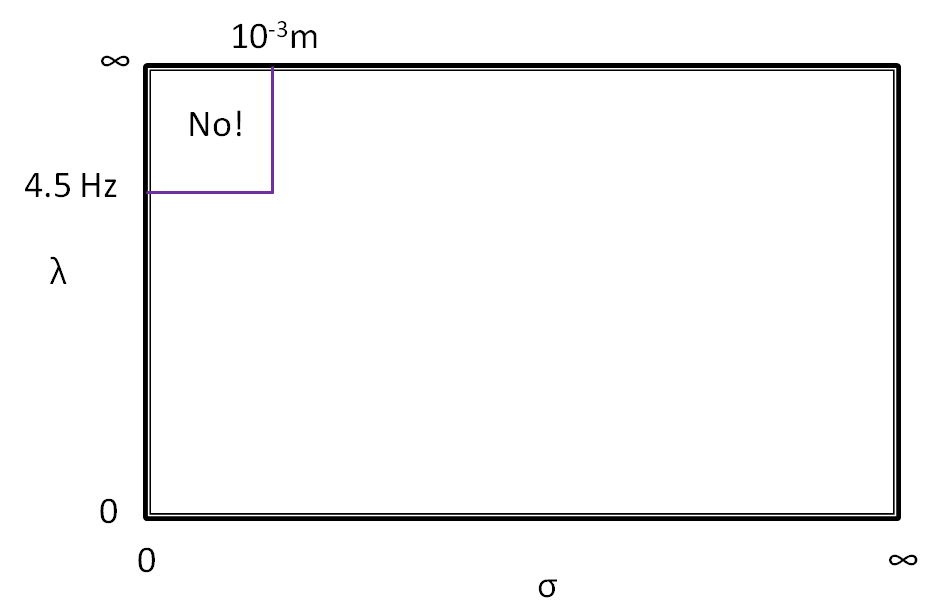
From a neutron double slit experiment performed by Zeilinger[1],
it has been determined that the region where 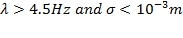 is forbidden. Above
4.5Hz, more than 10% of the neutrons will collapse before reaching the screen,
is forbidden. Above
4.5Hz, more than 10% of the neutrons will collapse before reaching the screen,
Unless  , in which case the collapse is sufficiently wide enough to
preserve the interference pattern. If a neutron’s wavefunction collapses to a
region small compared to the size of the screen, the interference pattern will
be destroyed.
, in which case the collapse is sufficiently wide enough to
preserve the interference pattern. If a neutron’s wavefunction collapses to a
region small compared to the size of the screen, the interference pattern will
be destroyed.
The (approximate) region forbidden by this experiment is shown
below.
I
have determined that the energy of a free particle of the form  is
is 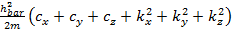 .
Since wavefunction collapse increases the value of the c parameters by
.
Since wavefunction collapse increases the value of the c parameters by  ,
,
The
change in energy of the system is  .
.
Weeks
4-5
I
am trying to find a way to model hydrogen collapse behavior as a function of
σ. Previously I analyzed hydrogen for a particular value of σ. The
difficulty stems from the inability to find analytical expressions for the
probability distribution of collapse and the energy change.
I
have determined from numerical analysis that the probability distribution of
collapse is of the form 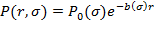 and the energy function is
  .
ΔE is simply the change in energy of the system should the collapse occur
at distance r from the proton. It is obvious from the symmetry of the ground state
wavefunction and the potential that only the distance from the center (r) is
relevant to the equations, there is no angular dependence for probability or
energy change.
.
ΔE is simply the change in energy of the system should the collapse occur
at distance r from the proton. It is obvious from the symmetry of the ground state
wavefunction and the potential that only the distance from the center (r) is
relevant to the equations, there is no angular dependence for probability or
energy change.
Week
6
I
tried another method of analyzing collapse behavior as a function of σ. I
attempted to solve the system analytically in Cartesian coordinated. I tried
modeling the initial wavefunction 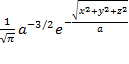 as a Gaussian of the form
 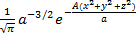 where A is the constant
that
allows the wavefunction to best approximate the true wavefunction. With this
method I was able to find the probability distribution of collapse as a
function of σ as well as the kinetic energy change as a function of
collapse center and σ,
but
I was unable to determine the potential energy function.
Week
7
A
problem that was discovered in the analysis of the Zeilinger double slit
experiment was given more consideration. It was assumed previously that if a
collapse occurs anytime during the particle’s flight from the slits to the
detectors,
the
interference pattern would be destroyed. In reality, collapses close to the
screen will not significantly disrupt the interference. The earlier collapses
happen, the more they will degrade the interference pattern.
We
came up with rough boundaries for λ and σ based on several factors.
One was a rough calculation from the Zeilinger experiment in which the region
λ>170Hz and σ<.0001m.
Another
rough boundary was the assumption that if the air (which was treated as free
particles) was heated more than .1 Kelvin per day it would be obvious.
This
analysis forbids the region where  using standard units.
Yet
another rough calculation reveals that if collapses were rare but powerful
(small λ small σ) they would produce audible sounds. Since we don’t
hear such sounds, the region where  is forbidden.
It
has been noted that if λ is sufficiently small, there will not be enough collapses
to collapse certain systems in the time it takes to perform a measurement.
If
this is the case, GRW theory does not solve the measurement problem and thus is
not a useful theory. The same restriction applies the region where σ is
large such that one collapse cannot sufficiently collapse the system.
In
this case, there needs to be many collapses to achieve the effect of one small collapse.
This means that the minimum value of λ rises with increasing σ.
Week
8
In
the final week I am working on an algorithm to simulate the interference
pattern in a double slit experiment with random collapses; this will allow for
a better estimate on the parameter restrictions.
For
the simulation, the problem is treated one-dimensionally using only the
component of the wave packet parallel with the slits.
[1]
A. Zeilinger, R. Gaehler, C. G. Shull, W. Treimer, and W. Mampe:
Rev.
Mod. Phys. 60, 1067 (1988).