
With the Cayley-Dickson Process in hand, the ostensibly insurmountable task of constructing the Octonions from the Real numbers may be reduced to the simple-minded application of an algorithm. In the course of our construction, we shall encounter some familiar number systems, now recast as various "double algebras."
A moment's thought reveals that R may be regarded as a one-dimensional real algebra over (surprise!) the real numbers. Being a vector space, R must have a basis; and while any non-zero number will do, surely no one would protest that 1 looks the nicest. It's also trivially verified that the identity map on R meets all of the criteria of a conjugation map.
Applying the Cayley-Dickson Process to R we obtain a two-dimensional algebra which we shall call C. We justify our choice of letters by thusly identifying the basis elements, (1,0) and (0,1):
Indeed, the algebra we've just constructed is none other than the Complex numbers. Expressing an element of C in the familiar form of a+bi amounts to merely writing it in terms of the basis given in (1).
A central theme which we shall visit and revisit throughout our discussion is the cost of doubling, for after each iteration of the Cayley-Dickson Process, we'll find absent in our new, larger algebras more and more of the properties which made R so nice in the first place. Our first casualty is self-conjugacy: no longer in C are all elements their own conjugates. A paltry price, indeed; but rest assured that subsequent steps will exact sharper tolls.
We shall now continue in exactly the same fashion, producing Hamilton's Quaternions from the Complex numbers. We make the following assignments to the four basis elements of H:
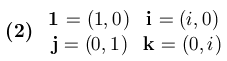
Thus, we obtain the familiar "i, j, k" basis for the Quaternions. These elements multiply in a manner reminiscent of the cross-product in R³. In particular, we have the following relations, verifiable via direct computation.
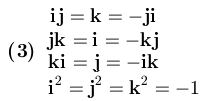
Quite clearly, it is commutativity which we sacrifice when making the transition from C to H. In view of the Alternate Realization of the Cayley-Dickson Procedure, it is the commutativity of C that ensures the associativity of H. Conversely, the Quaternions' failure to commute will manifest in the non-associativity of their double-algebra, the Octonions.
By now, our discussion has hopefully become dry and predictable. The Octonions are merely ordered pairs of Quaternions having the following basis:

A word of caution: unlike the other bases here presented, the above Octonion basis is not "standard" as there exists no consensus among the mathematical community as to what constitutes the standard basis for O. The basis we've chosen was not selected for its computational merit but rather for it best matching the spirit of the presentation.
To observe that Octonion multiplication is non-associative, we need only consider the basis elements:

I must admit that the foregoing discussion somewhat unfairly portrays the Octonions as little more than an ungainly, eight-dimensional curiosity. However, O does still manage to retain a number of nice properties enjoyed by its subalgebras, R, C, and H.
The first two of these properties illustrate the interplay between multiplication and the Euclidean norm:

The first of these identities succinctly states that the Octonions form a composition algebra with respect to the Euclidean norm on R8. It is, in fact, a classical theorem of Hurwitz which states that R, C, H, and O form an exhaustive list of the real, composition algebras. The latter statement regards the "conjugate-norm" relationship and follows immediately from the Cayley-Dickson multiplication rules. Nonetheless, it demonstrates that each nonzero element of O has an inverse which is a scalar multiple of its conjugate. The astute reader may verify that these two properties actually guarantee a unique two-sided inverse for each nonzero Octonion.
While Octonion multiplication is not, in general, associative, the preceding two contions afford what is called "weak associativity" or alternativity:

This property is extremely handy when deciding whether it's permissible to juggle parentheses. Those interested in seeing a proof should consult Morton Curtis's Abstract Linear Algebra.