next up previous
Next: Examples Up: Automated Proofs of Combinatorial Previous: Automated Proofs of Combinatorial

Definitions

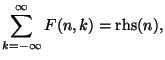
Hypergeometric identity:

$\displaystyle \sum_{k=-\infty}^{\infty} F(n,k) = \mathrm{rhs}(n),$    

where both $ \frac{F(n+1,k)}{F(n,k)}$ and $ \frac{F(n,k+1)}{F(n,k)}$ are rational functions of $ n$ and $ k$.

Standard form for hypergeometic series:

$\displaystyle {}_{r}\mathrm{F}_{s} \left[ \genfrac{}{}{0pt}{}{ a_1, a_2, \dots,...
...ac { (a_1)_k (a_2)_k \cdots (a_r)_k } { (b_1)_k (b_2)_k \cdots (b_s)_k k!} z^k,$ (1.1)

where

$\displaystyle (a)_k \overset{\mathrm{def}}{=} a(a+1)(a+2)\cdots(a+k-1);$    
$\displaystyle (a)_0 = 1,$    

so $ k!$ can be written as $ (1)_k$.

From (1.1), the ratio

$\displaystyle \frac{F(n,k+1)}{F(n,k)} = \frac{(k+a_1)(k+a_2)\cdots(k+a_r)}{(k+b_1)(k+b_2)\cdots (k+b_s)(k+1)}z.$    


Math Guest 1 2004-08-10