


Next: The WZ Method
Up: Automated Proofs of Combinatorial
Previous: Definitions
Many well-known series, including those that are encountered in
elementary calculus courses, are hypergeometric. For instance,
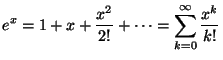
McLauren series for  :
:
Example 1
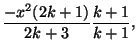
The ratio

, is clearly a rational
function of

and

, so we can write:
Here are two more examples:
Next: The WZ Method
Up: Automated Proofs of Combinatorial
Previous: Definitions
Math Guest 1
2004-08-10
![$\displaystyle e^x = {}_{0}\mathrm{F}_{0} \left[ \genfrac{}{}{0pt}{}{-}{-} ; {x} \right]$](img16.png)




![$\displaystyle \sin x = x {}_{0}\mathrm{F}_{1}
\left[ \genfrac{}{}{0pt}{}{-}{3/2} ; {\frac{-x^2}{4}} \right] .$](img21.png)


![$\displaystyle \arctan x = x {}_{2}\mathrm{F}_{1}
\left[ \genfrac{}{}{0pt}{}{1/2,1}{3/2} ; {-x^2} \right] .$](img25.png)