Next: Preliminary results
Up: Automated Proofs of Combinatorial
Previous: Examples
The WZ method is explained in [1, Chapter 7].
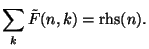
Consider
Let
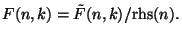 Then
Then
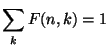 |
(3.1) |
(3.1) can be proven by finding a rational function  such that
 |
(3.2) |
Using (3.2) when  , we can find that
 .
Solving (3.2) for
.
Solving (3.2) for  , we obtain:
![$\displaystyle R(n,k+1) = \frac{F(n,k)}{F(n,k+1)} \left[\frac{F(n+1,k)}{F(n,k)} + R(n,k) - 1 \right].$](img34.png) |
(3.3) |
From (3.3), we can find  ,
,  and so on.
Then we get a system of equations:
Next: Preliminary results
Up: Automated Proofs of Combinatorial
Previous: Examples
Math Guest 1
2004-08-10