
General Information • Project Description • Project Log
Student: |
Ryan Ward |
Contact: |
ryan.ward@bucknell.edu |
Home Institution: |
Bucknell University |
Faculty Advisor: |
Dr. Gene Fiorini |
Project: |
Graph Pebbling |
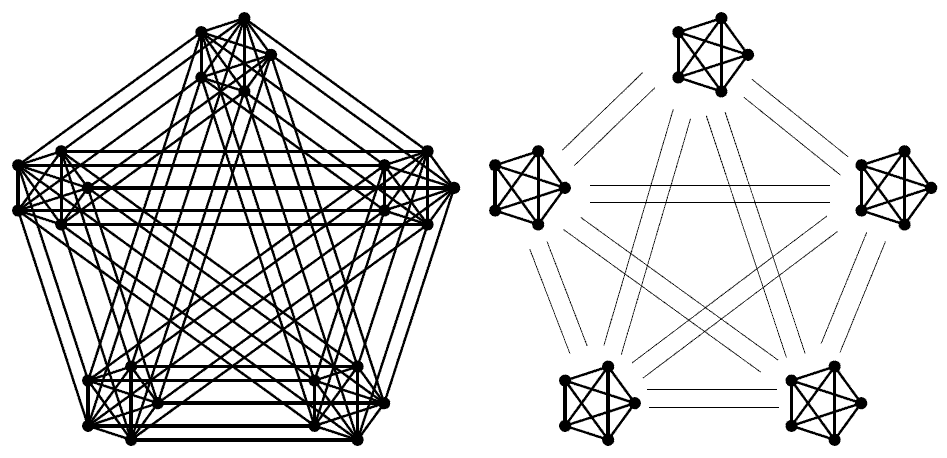
Let n pebbles be distributed onto the vertices of a simple graph G. A pebbling move consists of removing two pebbles from a vertex and then placing one pebble at an adjacent vertex. We call a distribution of pebbles on a graph solvable if, after a series of pebbling moves, it is possible to have a pebble at any given vertex. The pebbling number of a graph, π(G), is the minimum number of pebbles needed to guarantee that every distribution of π(G) pebbles is solvable. Our goal is to determine π(G) for certain types of graphs, as well as other related questions.
Graph Pebbling Introduction Presentation
Pebbling on Cartesian Product Graphs, Final Presentation
Week 1: Arrived at Rutgers University. Introduced to multiple possible problems.
Week 2: Literature review of graph pebbling. Gave brief introductory talk.
Week 3: Played around with multiple open conjectures to get a sense of different problems.
Week 4: Investigated pebbling numbers of certain cartesian product graphs.
Week 5: Worked on proving that one family of cartesian product graphs is class-0.
Week 6: Considered more approaches to working with cartesian product graphs in general. Switched to showing that the family of cartesian product graphs satisfies Graham's conjecture.
Week 7: Worked on final presentation and continued playing with the family of cartesian product graphs.
Week 8: Summarized work done during the summer and prepared for departure from Rutgers.